Research

TWIN2EXPAND will enhance research capacities in evidence-based urban design and planning (EBDP) as a field of critical importance in the R&I of integrated approaches and technologies for effective spatial planning and sustainable urban governance. The project facilitates a partnership among University of Cyprus, three leading institutions in the field (University College London; Chalmers University of Technology; Polytechnic University of Turin) and one pioneering SME practicing EBDP (Space Syntax Limited). By addressing urban sustainability, TWIN2EXPAND will contribute to achieving targets of the Cyprus Smart Specialisation Strategy, the EU Green Deal and the Sustainable Urban Development Goals. The strategic objectives of the project are to enhance research excellence and promote interdisciplinary research and networking in the EBDP field, and to make a broader impact on the scientific community and society.

TWIN2EXPAND embraces the international networking ethos of the SDGs to achieve scientific excellence in the R&I of the built environment, fully embedding it within the quadruple helix by fostering collaboration with local authorities and other stakeholders. It aims to achieve a scientific and integrative approach to urban planning and governance as the entry point into effective transitioning to sustainable development. Focusing on emerging concepts and challenges in the field, the project proposes a generalised conceptual and working model of evidence-based urban design and planning.

By embedding open science practices within the project’s activities, TWIN2EXPAND will make significant contributions to research excellence, scientific advances and societal progress, implementing three pathways to maximise substantive real-world impact:

  1. innovative capacity-building in research management and excellence in the EBDP field;
  2. co-creation of evidence-based urban design and planning knowledge; and
  3. emphasis on translation of scientific knowledge to professional practice knowledge

The main objective is to develop, pilot and assess innovative educational methods, tools and material towards an integrated planning approach that takes –holistically- into account urban planning/design, mobility planning, participatory planning and evidence-based planning, since an integrated and holistic planning approach is essential for planning a people-centric, inclusive and climate-resilient city.

This novel approach is based on the rationale that, urban and transport actions for tackling climate crisis need to be considered in parallel and in combination, informed by state-of the-art evidence-based findings, and to be community-tailored through participatory planning to ensure the ownership of these measures by all stakeholders, and ultimately their efficiency and long-term prospect.

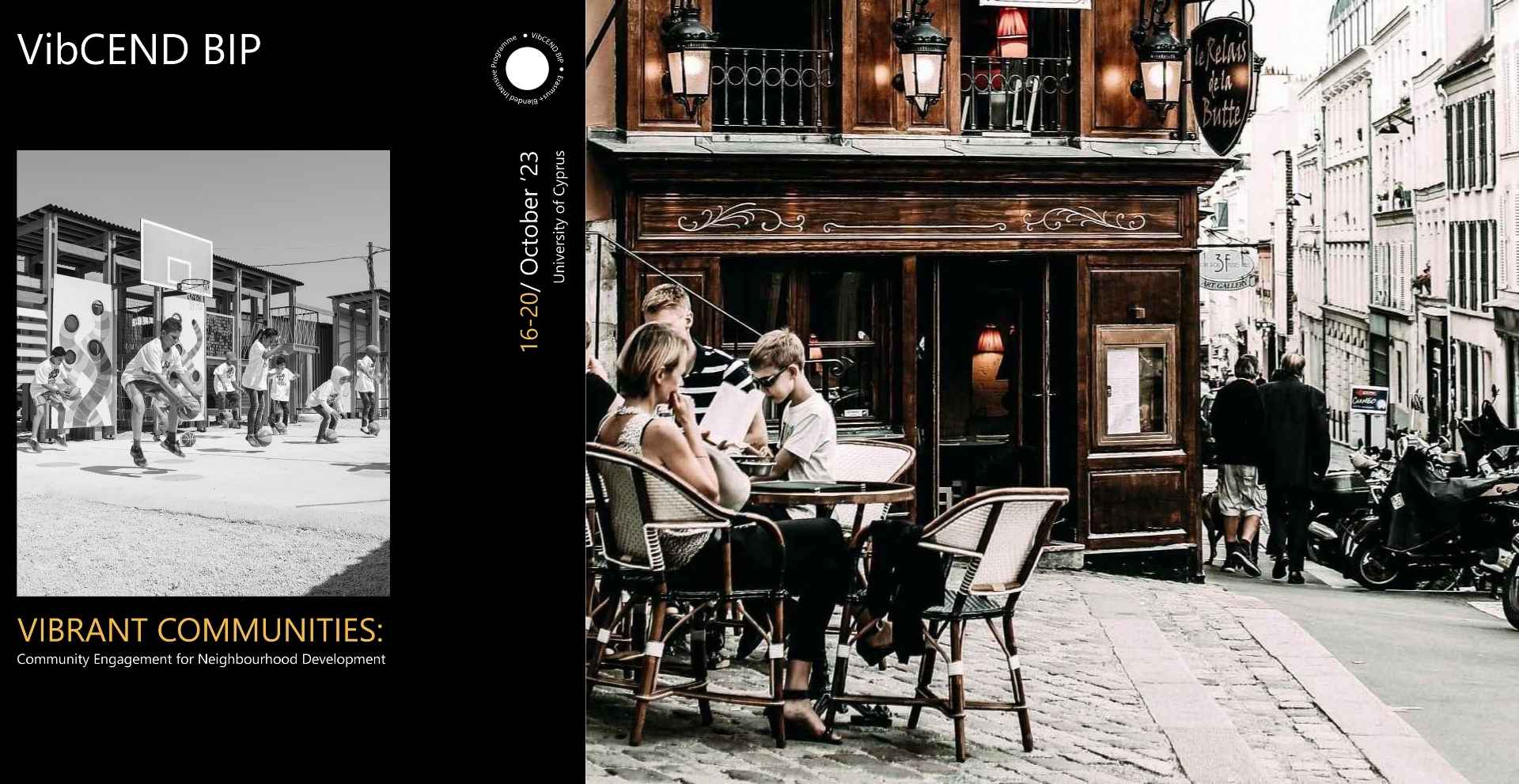
VibCEND is funded by Erasmus+ Blended Intensive Program (2023) and aims to engage students to collaborative design approaches in diverse social, economic, and technological neighbourhood contexts.

It provides students with the knowledge and skills needed to operate in contemporary collaborative environments, utilising the skills and knowledge of others, and becoming transdisciplinary practitioners, responding in a reflective and empathetic manner to the demands, constraints and opportunities afforded by the context within which design practices occur and by the engagement between people, materials, and technological practices.

Within the framework of KAEBUP (Knowledge Alliance for Evidence Based Urban Practices) (2022 – ongoing) a new toolkit is being developed by ALA Planning Partnership in collaboration with the University of Cyprus STAMP is designed as an accessible, user-friendly resource for developers, designers and planners to assess and enhance the sustainability of a proposed master plan.

It includes fourteen clear sustainability parameters, each with guiding questions that generate a graphical output showing how the design can be improved. The tool has been tested through workshops at the University of Cyprus, Frederick University and Neapolis University, and has also been presented to government authorities and practitioners for feedback.

Housing and Urban Commons is funded by Erasmus+ Blended Intensive Program (2022) and aims to strengthen theoretical, methodological, ethical and professional skills on the sustainable 21st-century city and the SDGs.

Grounded in Lefebvre’s “right to the city” and recent work on the urban commons, it promotes socially sustainable, bottom-up approaches to participatory placemaking. The programme combines lectures, collaborative workshops and neighborhood field visits, with participants completing a five-day mobility period in Lisbon, Coimbra and Porto, complemented by a mandatory virtual component contributing to the overall learning outcomes.

KAEBUP’s main objective is to create an international educational and training method offering participants the opportunity to engage with professional environments, learning how research can be the basis for innovative professional practices and what businesses in the field of planning, architecture and urban design require from academia. Successful enterprises in Europe have made research outputs the core element of their practice to address pressing urban challenges including sustainability, mobility, health, and social cohesion. KAEBUP’s partners comprise HEIs, NGOs and enterprises from different European cities, who have expertise of evidence-based design and wish to strengthen the links between businesses and HEIs to mutually benefit from the tools that research can provide to enterprises and from the experience of evidence-based practice. The cooperation between KAEBUP’s partners will be the key for addressing current needs and developing future educational systems providing students with the skills to enter the professional world and inspiring HEI staff to innovate through research.

KAEBUP will achieve its objectives by implementing three ‘pathways to evidence-based urban practice’:

  1. Innovating learning and teaching through knowledge exchange and skills development working on real-life urban projects.
  2. Understanding and developing business models for evidence-based urban practices.
  3. Co-creating urban knowledge through multiple modes of exchange and involvement of students, teaching and company staff in teaching, research, and practice.

KAEBUP will foster entrepreneurial mind-sets among HEI students and staff and benefit businesses through broader access to research outputs and clearer communication of how academia can support them. The Alliance will also produce clear and transferable results in relation to how urban studies curricula can best support transversal skills development.

Housing in many European countries has become unaffordable for many. In fact, it is now considered to be one of the most important national issues in Europe and its solution is proving very challenging. Providing affordable and sustainable housing is a complex task involving multiple disciplines, sectors and actors and requires transdisciplinary research.The EU-funded RE-DWELL project will train 15 early-stage researchers (ESRs) in design planning and building, community participation, and policy and financing, providing them with the capacity to operate across fields and sectors, generating innovative solutions for the housing problem in the EU.

ACT combines architectural education, urban conflict theory, peace education principles and social psychology’s contact hypothesis to examine whether thinking about space and the city can mitigate conflict-induced biases between adversarial groups and create the basis for policies involving shared spaces, infrastructures and the public realm within a divided city. Consequently, ACT explores the act of design and urban planning as a conflict transformational process; it is a pedagogic research project which aims at the integration of different approaches to urban conflict issues, from both the social and the spatial sciences, through pedagogic innovation and Information and Communication Technology (ICT). It aims at establishing a platform of collaboration to address conflict challenges faced by contemporary cities from a multidisciplinary perspective. The key objective of the project is to develop an innovative system of teaching urban conflict transformation, bridging across research and institutional boundaries in educational cultures, through the act of design and the development and use of digital resources.

SUGAR aims to develop innovative best-practice protocols and guidelines on Sustainable Urban Governance and specifically Public Participation through Augmented Reality.  The project’s key activities include: research in urban governance, augmented reality and public participation to develop a Sustainable Urban Governance framework through AR specifically designed for implementation in the Cypriot context and use of an ‘experimental research’ framework through design thinking to implement, coordinate and monitor such a participatory planning model through a workshop format in Cyprus facilitated by the entire consortium bringing together the public and planning experts.